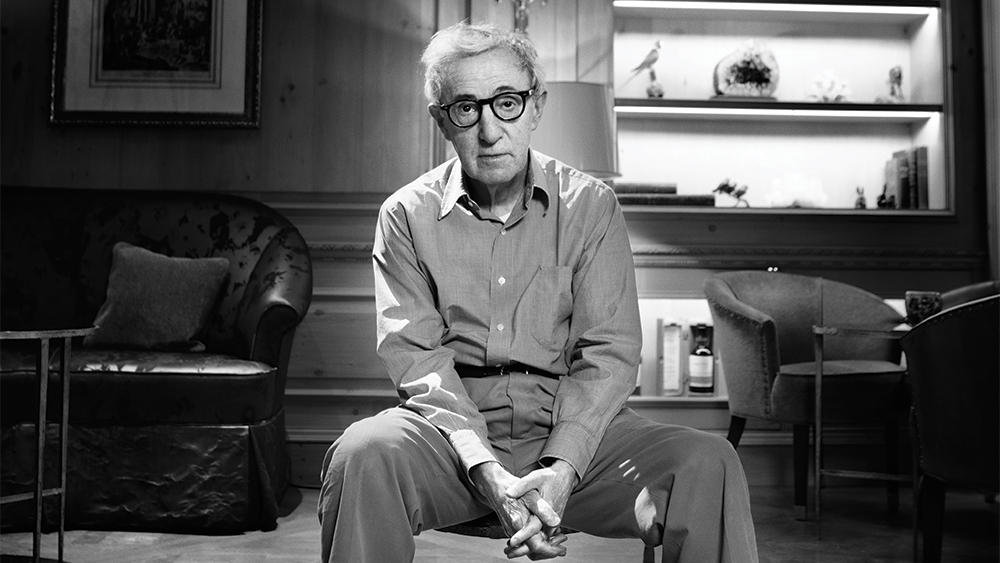
Woody Allen is one of the most celebrated filmmakers of all time. Throughout his career, he has received a considerable number of awards and accolades in film festivals, and award ceremonies that have praised his work as a director, screenwriter, and actor. He has won four Academy Awards, two Golden Globes, and ten BAFTA Awards. He is a recipient of the prestigious Cecil B. Demille Lifetime Achievement Award. And often considered one of the greatest influences in film.
He is also a sexual predator.

Allen was first accused of sexually molesting his adopted daughter, Dylan Farrow, in 1992 – she was just 7 years old at the time. Later, Allen’s longtime partner Mia Farrow discovered explicit photos of her adopted daughter, Soon-Yi in Allen’s possession and learned he was having an affair with her (who he later married). A girl that Allen and Farrow raised together since she was a child.
In 2014, Dylan wrote an open letter in the New York Times detailing the heinous acts she endured from Allen during her childhood. Since that letter, Allen has continued making films and receiving praise for his works.

Despite that we are living in a world post-Weinstein scandal, and in this era of #MeToo and #TimesUp, Allen will most likely continue to work in Hollywood with relative impunity.
This ‘get out of jail free’ card is not only extended to Allen. We have a habit of forgiving men with unsavory track records – mostly because they are critically acclaimed ‘artistic geniuses.’
Director Roman Polanski was convicted in 1977 of raping a 13-year-old and fled the U.S. to avoid imprisonment. After this incident, more than 100 filmmakers signed a petition for his release. In 2002, he won Best Director for The Pianist and received a standing ovation. Actor Sean Penn had a history of domestic abuse during his short marriage to Madonna – even allegedly beating her with a baseball bat. He has since won two Academy Awards, a Golden Globe and Screen Actors Guild Award.
Kevin Spacey, Kobe Bryant, Louis CK, Oliver Stone, Dustin Hoffman, Bill Cosby, Alfred Hitchcock, Quentin Tarantino, Casey Affleck – what do they have in common?
They did something awful and made something great.
With the knowledge of the creator’s transgressions, do we turn a blind eye, or collectively boycott? Maybe it’s time to do away with the idea of “separating the art from the artist.”
Attribution theory deals with how the social perceiver uses the information to arrive at causal explanations for events. It examines what information is gathered and how it is combined to form a causal judgment. (Fiske, & Taylor, 1991)
Aka, our judgments of a person and their actions are influenced by the assumptions we make. Therefore, it is easy for us to make excuses defending people whose works have been important and influential to us.
This process also shows that we tend to be harder on artists whose works aren’t as cherished. Director Brett Ratner, for example, was accused of sexual misconduct by six women last year. Since being exposed, Ratner has been cut from many of his business ties, including being dropped from his $450 million production deal with Warner Brothers. Ratner is a successful director but his works, which consist of mainly big-budget action films, were never praised on the same critical or artistic level as the works of Allen or Polanski – which is why Ratner’s public scrutiny is held to a much different standard.
Due to fundamental attribution error (Ross, 1977), aka the correspondence bias, we place an internal fault to people we are biased against, and external faults to those we praise. People who strongly identify with a celebrity are less likely to react negatively than people who don’t identify with the celebrity. (Johnson 2005)
The 2005 trial of Michael Jackson was a polarizing spectacle that split America in half. You either believed he molested the minors that accused him in court, or you thought it was a frivolous lawsuit led by fame-seeking and money hungry parents trying to capitalize off of Jackson’s fame and wealth.

Those who revered Jackson and his works defended him relentlessly. The common narrative being he was a tragic figure, who never had a normal childhood and was just an eccentric kid at heart. There were others who saw Jackson as a freak, or as a sexual deviant, their accounts were much different placing the blame on Jackson directly.
Historian Martin Jay coined the term “the aesthetic alibi” which essentially means that the art excuses the crime. Jay writes that in the 19th century, artistic genius was “often construed as unbound by nonaesthetic considerations – cognitive, ethical, or whatever.”
When we consider the work of artistic geniuses, we don’t want the reputation of their works tarnished, especially to those we hold the dearest, because what does that say about us? If my favorite film is Manhattan, does that make me a supporter of sexual assault? Instead of unpacking that kind of mental anguish, it’s easier for us to just brush off the controversy at hand. Which is what makes us complicit in the perspective of the abuser.
When asked why he pursued a relationship with Soon-Yi, Allen responded “The heart wants what it wants.” a cop-out phrase in which one takes zero accountability for their actions. A confirmation bias which describes the tendency in which people attribute their own behaviors to external causes. (Berry, Poortinga, Segall, & Dasen, 2002; Ross, 1977).
Allen went on: “There’s no logic to those things. You meet someone and you fall in love and that’s that.”
But here’s the thing: If a work of art is spoiled by learning the conditions which it was made, then perhaps the artist isn’t as remarkable as we thought.
 Jennifer Durnell