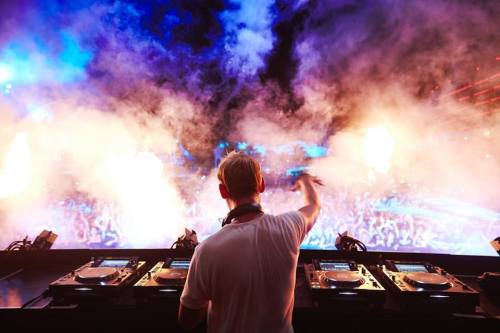
It’s March 17th, 2013. Young Swedish DJ, Tim Bergling, better known as Avicii, is about to take the stage at Ultra Music Festival, the largest electronic music festival in the United States. His set is strategically positioned between two of the most recognizable names of the genre at the time: Calvin Harris and Tiesto.
Little did we know, his performance that night was going to change the landscape of EDM as we know it.
Avicii opened his groundbreaking set with his 2011 hit single “Levels,” a song that defined electronic music for a new generation of ravers that catapulted him into mainstream superstardom.
In the same vein of shock and confusion that the world felt when Bob Dylan decided to go electric, Avicii did the unthinkable: he unveiled a bluegrass band at an electronic festival… in front of 150,000 people.
Accompanied by R&B artist Aloe Blacc, with a full string arrangement in tow, including banjos, fiddles, and a violin, Avicii debuted his divisive single “Wake Me Up,” coining a new genre, now known as Folktronica.
“Wake Me Up” became the soundtrack for the summer of 2013. It was the first track to reach 200 million streams on Spotify and peaked at #4 on the Billboard Hot 100. Starting a revolution that proved EDM was no longer a genre on the fringes of the counterculture. It had finally crossed over into the mainstream.
His untimely death last Friday is not only a loss for ravers but a loss for anyone who consumes popular culture.
Suddenly EDM artists weren’t exclusively playing in nightclubs, they were selling out arenas. Avicii himself was the first DJ to ever headline the prestigious Radio City Music Hall in New York City. Coachella and Lollapalooza cashed in on this new relevance of electronic music by adding DJs as headliners to their historically rock-oriented lineups.
In the year following Avicii’s influential Ultra set, electronic music became the fastest growing music genre in history.
Top 40 radio is currently monopolized by EDM and pop crossover hits. Looking at today’s Billboard charts, the current #1 song in the country is “The Middle,” by Zedd. Other EDM tracks simultaneously navigating the charts include singles by Marshmello, Calvin Harris, and The Chainsmokers.
None of this would have been possible without Avicii, who perfected the modern template of EDM, ushering the genre to common vernacular.
Electronic music began gaining traction in the latter half of the 1970s as the music of disco began diverging from its traditional orchestration. The use of synths and drum machines began driving anthems for disco artists such as Donna Summer. Rock-based acts like Kraftwerk began experimenting with these methods, creating the foundations of early electronic music.
By the 1980s, Depeche Mode, A-ha, and Pet Shop Boys combined the structure of rock music while adding electronic elements, illustrating the cycle of new-wave and synthpop that defined the era’s counterculture. The men of new-wave often broke societal gender norms, characteristically draping themselves in tight black clothing, rimming their eyes with coats of dark eyeliner, and styling their hair in unconventional and feminine ways.
Proving that, despite the mainstream success that the genre saw, new wave (and electronic, by extension) was inherently, alternative.
On the fringes of the underground dance club and rave scenes that spilled over into the 1990s, began the third wave of EDM with the boom of techno, house, and trance.
This music was not as easily accessible as it’s predecessors – many of the songs repetitive in nature, featuring rapid BPM’s, predominantly instrumental, and notable for their peaks and drops and long-form arrangements. This was not the music your mom was listening to.
In the late 1990’s Daft Punk, Fatboy Slim, and Moby became exceptions to the rule, showing that electronic music can not only be popular – but have critical merit. The music was heavy with auto-tuning and featured robotic components. These arrangements, were fresh and exciting at the time, became the standard prototype.
The mid-2000s began the era of Super Star DJs such as Steve Aoki, Tiesto, David Guetta, and Deadmau5. They exclusively played at premiere nightclubs around the world and were full-fledged celebrities. Notorious for their extravagant tour riders, grandiose yacht parties off the coast of Ibiza, and fraternizing with supermodels. Being a household name gave them the platform of notoriety, but it wasn’t enough to grant them enough credibility to break into mainstream radio.
EDC Las Vegas debuted in 2011, supplying a crowd of over 200,000. Proving that EDM was slowly on the rise. But who would become the poster child of the genre? Skrillex’s brand of dubstep was too unorthodox to possess universal appeal, Calvin Harris was still exploring his persona outside of indie, and Steve Aoki was complicit simply existing to throw cakes into his audience.
Like the parting of the red sea, there was Avicii: pure, and unpretentious. He did not care about superstardom, he was not motivated by cultivating his celebrity brand, he just wanted to produce good music. This authenticity set him apart and allowed him to explore new terrains pushing the boundaries, blending pop, and electronic music.
Rock ‘N roll had Hendrix, punk had Sid Vicious, country had Hank Williams, jazz had Amy Winehouse, grunge had Kurt Cobain, and now EDM has Avicii.
These tragic figures, combusted in the limelight before our eyes. Fame is a blessing and a curse. You become worshipped, and with that comes wealth and power. The burden of celebrity is that nobody tells you no. You are no longer restrained from accessing unlimited supplies of drugs and alcohol due to the financial setbacks you once had. You are surrounded by admirers who encourage every move you make – even when they are destructive.
This combined with addiction and mental illness is a recipe for disaster.
Avicii – a stage name derived from the Sanskrit for the deepest stage of hell, the inverse of Cobain’s Nirvana. Along with being pioneers in their respected genres, they both struggled with the fame that their art bestowed upon them.
After nearly a decade of being the face of EDM, his partying, excessive drinking, and nonstop traveling finally took its toll. In 2016, at the age of 26 Avicii announced that he was retiring from touring so he could focus on his health. He spent the next two years finding his own nirvana in the studio.
His death was a devastating shock to the world. His life was a cautionary tale, he’s not the first celebrity to have a tragic and untimely death, and he won’t be the last.
“We all reach a point in our lives and careers where we understand what matters the most to us,” Bergling wrote to fans on his website. “For me, it’s creating music. That is what I live for, what I feel I was born to do.”
 Jennifer Durnell